


A Beginners Guide to Mat Pilates


Written by: Kenzie Bicher
In our last post, we talked about the benefits of a consistent Pilates practice. Now you know how Pilates can support your training and nurture your body, but what does it actually feel like to be in the room for a class? Reading about it and doing it are two different things, and that gap is usually where hesitation lives. Before we get into it, there are a few myths I want to crack.
Myth #1: You must be flexible
Much like yoga, Pilates has no physical prerequisites. Flexibility isn’t a prereq, it’s the result of showing up again and again. Skilled instructors take you through Pilates exercises usually in layers, taking one movement and then layering another, until you create a compound exercise that tests muscular endurance, balance, and mobility.
Take a simple leg lift on your back – on its own, it’s a small movement; but let’s layer on:
- Add a pulse, and it starts building endurance.
- Add a hold, and it challenges stability.
- Add a slow lower, and your hip flexors, deep core, and stabilizing muscles are all firing together.
This layering method is what makes Pilates feel like more than the sum of its parts, and it’s also what builds flexibility over time without ever stretching for the sake of it. Pilates is the place where exercises provide a scaffold to supplement mobility and flexibility practice, while building strength over time.
Myth #2: You must be “in shape”
Pilates principles were built to rehabilitate injured dancers, so the foundations of Pilates are designed to meet every body with modifications built in.
Working through an injury? Pilates provides foundational strength exercises to support the muscles around an injured area.
Pilates works with your unique body, instead of against it. All classes begin with body weight with the option to add on light load as you progress. Our instructors are trained to offer options as you go so there are versions of each movement available to everyone. The idea is that Pilates is low-impact, but that doesn’t mean it’s easy.
Myth #3: Low impact means easy
Low-impact means your joints are safe — it does not mean your muscles are riding into the sunset while you spend 60 minutes not getting a full-body workout. This is often the most common misnomer.
Have you seen the TikToks of firemen (and women) shaking beyond belief in a mat Pilates class? Because that is the truth of it.
- That shake isn’t a sign something’s wrong.
- It’s your muscles working at the edge of their endurance.
- It’s holding a position instead of powering through a rep and moving on.
- And the shakes come for everyone, the people who have never done a class, and the ones who come time and time again.
Who is mat Pilates for?
Short answer: everyone. Climbers looking to fine tune their stabilizing muscles. Heavy lifters evening out their imbalances between their dominant and non-dominant sides. Runners keeping their knees and hips happy through their training cycle. And people who want to move well and feel strong. Pilates fits alongside whatever else you’re doing, or it stands on its own.
Your first Pilates class, without the intimidation: Here’s what you need to know
What to wear: Comfortable clothing you can move and sweat in. Layers are nice too, since you can shed them as you start to heat up.
What to bring: A water bottle to stay hydrated, and possibly a small towel to wipe sweat. Mats and props are provided!
What to expect: Classes vary by instructor, but each starts with breathwork to connect mind to body and a gentle warm-up that primes the muscles the main sequence will target. Expect the pace to feel slower than a cardio class and more demanding than it looks: instructors often count reps out loud or cue a tempo, like a 3-count lower, because control is the point, not speed.
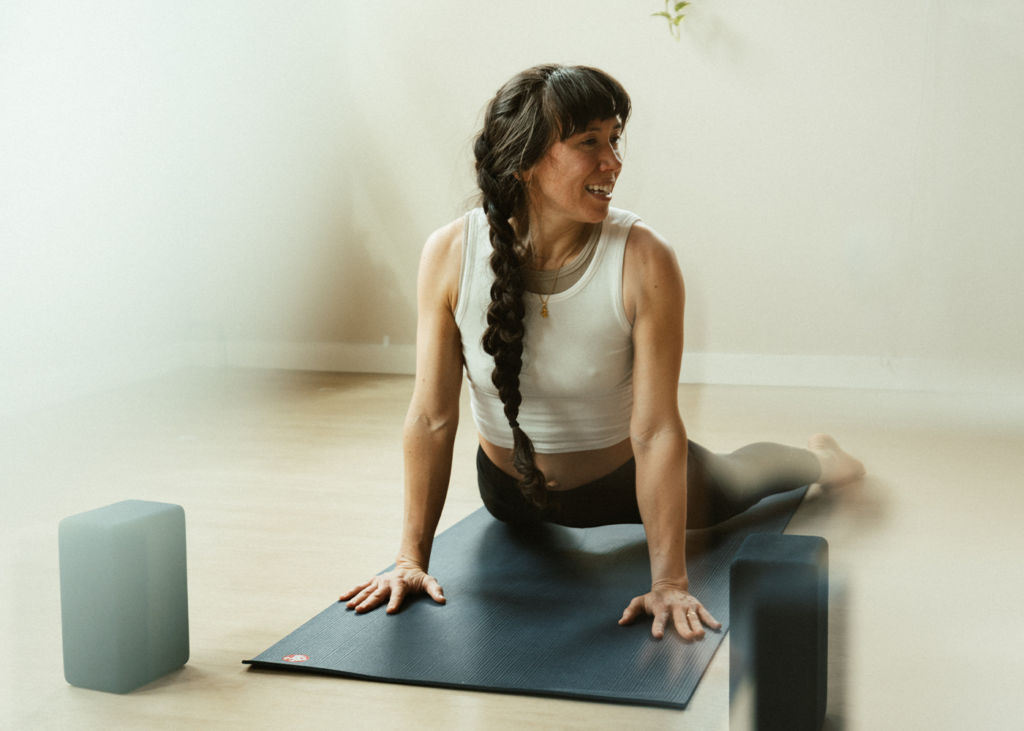
Some classes only use bodyweight. Others load the exercises with light resistance bands, light weights, a Pilates ball, or yoga blocks, depending on the props available at each location. You’d be surprised how heavy 3 lb weights get over a 5 minute arm set!
Each class is a full-body workout, so expect to target your core, legs, arms, and back before ending with a few stretches and breathwork to calm the nervous system.
Wanna give it a try?
The only real prerequisite is curiosity, and a willingness to shake through the last few reps. Are you in?
Meet us on the mat. Check out our fitness class schedule here.
About the writer: Kenzie teaches yoga and Pilates at Seattle Bouldering Project, where she explores the connection between movement and language as intertwined forms of expression. With a foundation in somatic practice, her writing is embodied, visceral, and invites readers into a holistic experience.
Climbing and Community: The Boston Indoor Climbing Scene
Written by: Anne Riddle-Cruz Analog Connections: Boston’s Indoor Climbing Scene Boston knows a thing or two about athletic excellence. Climbing...
A Beginners Guide to Mat Pilates
Written by: Kenzie Bicher In our last post, we talked about the benefits of a consistent Pilates practice. Now...
How to Start Rock Climbing in Austin
Written by: Anne Riddle-Cruz Step Onto the Pads: How to Start Rock Climbing in Austin Austin is one of...
The Best Places to Go Rock Climbing in Austin
Written by: Anne Riddle-Cruz Central Texas Limestone: A Local’s Guide to Rock Climbing in Austin The city of Austin...
Bouldering Project’s Signature Yoga Classes
Written by: Kenzie Bicher Bend, Don’t break. Our yoga classes are designed for flexibility, mindfulness, and strength. Gradually...
The Functional Benefits of Pilates
Written by: Kenzie Bicher The Functional Benefits of Pilates Pilates is a buzzword that pops up everywhere. If you've...