


The Functional Benefits of Pilates


Written by: Kenzie Bicher
The Functional Benefits of Pilates
Pilates is a buzzword that pops up everywhere. If you’ve never done it, it can feel like a mirage, ever elusive, always mentioned, never quite explained. What even is Pilates?
At its core (pun intended), Pilates is functional strength, longevity, and body awareness, built through consistent, varied work throughout the body. This post explores what’s actually happening in your body and brain when you practice, why it works differently than heavy lifting, and how often you need to show up to feel the difference.
A natural fit alongside climbing and yoga
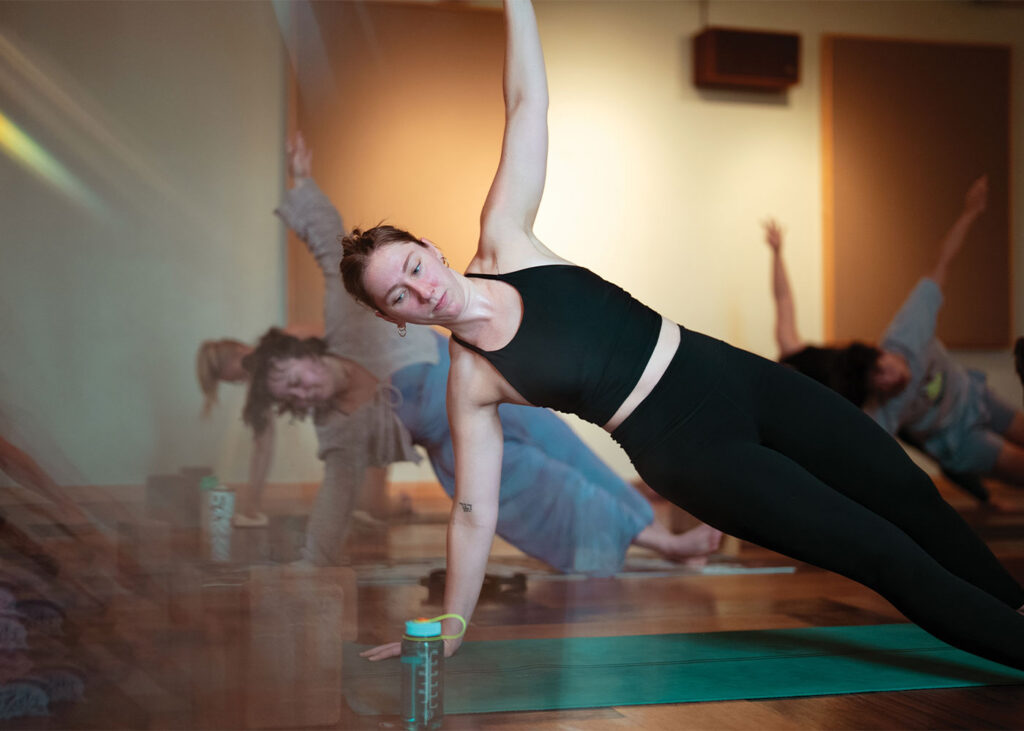
Progressive overload, the principle behind muscle growth, applies here, just with a slightly different outcome.
When you load a muscle in a way it’s not used to, your body adapts to meet the demand: with heavy lifting, that adaptation often shows up as larger muscle fibers. With Pilates, the resistance is lighter and the reps are higher, so the adaptation looks more like muscular endurance and neuromuscular control. This means your muscles get better at working longer without fatiguing, and your brain gets better at coordinating how they work.
This is neuroplasticity in action: with repetition, your nervous system gets more efficient at firing the right muscles at the right time, so movement that once felt effortful begins to feel automatic. The more consistently you return to this practice, the more you’ll feel the dividends.
With one to two classes a week, Pilates fits in smoothly alongside whatever active program you’re already following, whether it’s your running routine, your 4x-a-week climbing schedule, or your strength program. For climbers, yoga lovers, and traditional lifters alike, Pilates is a natural extension of your fitness journey.
What are the main physical benefits of doing Pilates regularly?
Pilates builds functional strength, joint stability, and body awareness through low-impact, high-repetition movement. Regular practice improves deep core control, corrects muscle imbalances, and strengthens the connective tissue around key joints: knees, hips, ankles, and shoulders. Pilates is a powerful complement to climbing, strength training, and everyday movement.
- Deep core control: Pilates trains the stabilizing muscles beneath your visible abs (like the transverse abdominis) that support your spine and pelvis during movement, not just the muscles that show up in a mirror.
- Muscle imbalances: Because Pilates works both sides of a joint and both directions of a movement, it catches and corrects the small strength gaps that heavier, less varied training can leave behind.
- Connective tissue and joints: Consistent, controlled loading strengthens the tendons and ligaments around your knees, hips, ankles, and shoulders, the tissue that stabilizes a joint but doesn’t get stronger from muscle work alone.
Done consistently, you’ll notice fewer of the lingering muscle imbalances that heavier, less varied training tends to leave behind.
The Mind-Body Connection
Much like yoga, Pilates works because it uses the connection between mind and body. Instead of muscling through a set, you’re paying attention to every single move: where your ribs are, whether your pelvis is tucked or tilted, which side is working harder than the other. That kind of attention builds body awareness, or proprioception, your sense of where your body is in space without having to look. That active awareness builds a pattern you carry with you: onto the wall, into your lifts, and into daily life.
Endurance Over Heavy Load
Traditional strength training is about heavy weight, low reps: three sets of six to ten, pushing toward failure. Pilates flips that script. It’s about endurance, light resistance, and high reps, tiring your muscles out through repetition and time instead of load. Thoughtful instruction pairs exercises in a way that builds progressive overload throughout class, working the same muscle group from a few different angles until it’s genuinely fatigued.
Your body craves this contrast. It’s how you round out the imbalances that heavy lifting alone can’t touch.
Recover Better
Pilates is a tool for active recovery: the light resistance and controlled movement keep blood flowing to tired muscles and joints without adding fatigue, so you come back to your primary activity (climbing, lifting, running, whatever it is) feeling looser and more recovered instead of just rested. Instead of nursing sore muscles for days after a hard session, you’ll likely notice that soreness clears faster and doesn’t linger into your next workout.
The Payoff
If you want to level up your climbing or your strength training, Pilates gives you the edge most people are missing. Commit to once a week for six weeks and see what changes:
- Your squats have more range.
- Your flagging is tighter, you know exactly where your body is in space on the wall.
- That nagging ache in your right knee after treadmill cardio? Gone.
I like to think of Pilates as the movement equivalent of perfect pitch: when you see someone who practices Pilates regularly, you just know, in the way they hold their posture, move toward a hold, or use their big toe as leverage against it.
Pilates is about cross-training, finding the balance between strength and mobility, endurance and control, hard training and recovery. That balance is what makes the difference.
Ready to feel it for yourself? Check out one of our mat Pilates classes here!
About the writer: Kenzie teaches yoga and Pilates at Seattle Bouldering Project, where she explores the connection between movement and language as intertwined forms of expression. With a foundation in somatic practice, her writing is embodied, visceral, and invites readers into a holistic experience.
Climbing and Community: The Boston Indoor Climbing Scene
Written by: Anne Riddle-Cruz Analog Connections: Boston’s Indoor Climbing Scene Boston knows a thing or two about athletic excellence. Climbing...
A Beginners Guide to Mat Pilates
Written by: Kenzie Bicher In our last post, we talked about the benefits of a consistent Pilates practice. Now...
How to Start Rock Climbing in Austin
Written by: Anne Riddle-Cruz Step Onto the Pads: How to Start Rock Climbing in Austin Austin is one of...
The Best Places to Go Rock Climbing in Austin
Written by: Anne Riddle-Cruz Central Texas Limestone: A Local’s Guide to Rock Climbing in Austin The city of Austin...
Bouldering Project’s Signature Yoga Classes
Written by: Kenzie Bicher Bend, Don’t break. Our yoga classes are designed for flexibility, mindfulness, and strength. Gradually...
The Functional Benefits of Pilates
Written by: Kenzie Bicher The Functional Benefits of Pilates Pilates is a buzzword that pops up everywhere. If you've...