


Why Bouldering is One of the Best Full Body Workouts


Written by: Kenzie Bicher
Intro
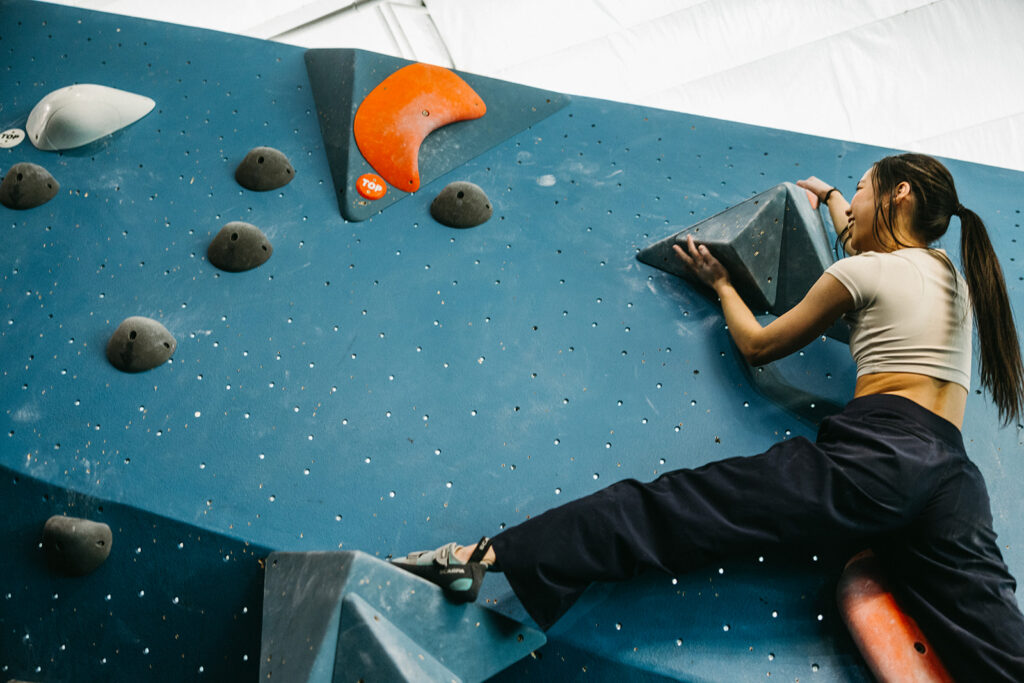
Think of the wall as your vertical laboratory. This lab is your opportunity to experiment, go for a hold just out of reach, try something new, and revel in the evolution as you go. Unlike traditional weight lifting, elements of bouldering add specificity, texture, and nuance to resistance training.
Over time, you begin to see and feel the layers of this unique training. Physical strength develops not only in the large muscle groups, but also in the smaller stabilizing tissues that support fluid movement. At the same time, navigating the wall with crisp awareness is a playful endeavor, recruiting more than our prime movers, but also smaller ligaments and tendons, and engaging our brains with a mental puzzle we are dying to solve.
Bouldering is a true full-body workout where we meld strength, coordination, mobility, and problem-solving. Once the obsession starts, it is impossible to stop.
Building muscle mass + endurance
Building muscle through bouldering works differently than traditional weightlifting, but the principles are the same: progressive overload. Traditionally, this is done by adding more weight or increasing repetition. In bouldering, progressive overload takes a different form. We use our body weight along with direction, verticality, and weight transfer to challenge muscles in new ways.
There are an infinite number of ways to load muscles as we climb. Each vertical movement on the boulder cannot be replicated, so each pass is a new stimulus for the body. Over time, our bodies become more efficient, learning to expend less energy while navigating the wall. Muscles get smarter through repeated patterns and refined technique, progressively strengthening fibers to build both muscle mass and endurance. Bouldering is the culmination of technical skill, subtle strength, and stamina, expressed through concise, deliberate movement patterns.
Grip, Forearms, and Connective Tissue
Bouldering actively develops physical grit. Muscles along the forearms and fingers, places you may not even realize you are using, often become sore after bouldering. This is a signal that these smaller, supportive muscles are working and adapting. Reaching, gripping, and holding onto tiny holds repeatedly puts a consistent load on the fingers, forearms, and shoulders.
Over time, this stress stimulates collagen production, gradually strengthening tendons and ligaments, improving joint stability, and contributing to a comprehensive full-body experience. Grip strength develops gradually, not through force, but through repeated exposure and adaptation.
When we use controlled, explosive reaches and dynamic movements to access holds slightly past immediate reach, these tissues learn to stretch and recoil more efficiently, almost like a spring. This improves the body’s ability to store and release energy, making repeated movements feel more fluid and less taxing over time. Tendons adapt slowly, but with consistent practice, bouldering builds durable, resilient connective tissue that helps prevent strains and sprains while supporting larger muscles as the body’s primary movers.
Improving Spatial awareness, Dexterity, Coordination, and Integration
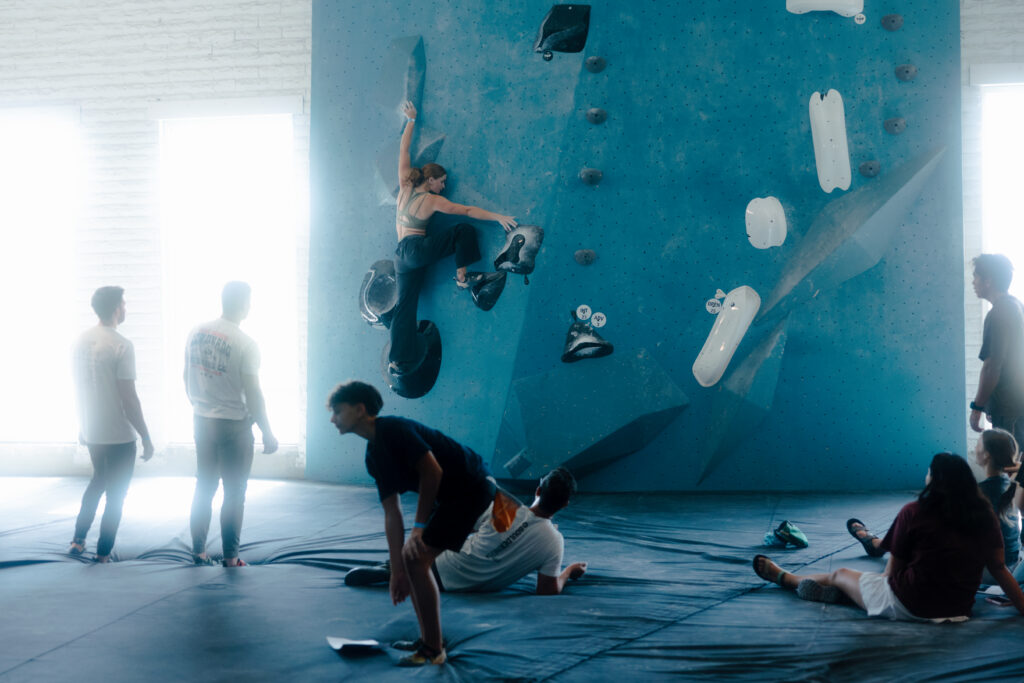
Bouldering refines spatial awareness, dexterity, coordination, and the integration of recovery. We develop a deeper understanding of where we are in space and how our bodies move within that space. As movement becomes more economical, precision begins to guide the process. Small adjustments create meaningful change, and the limbs begin working in tandem with greater efficiency.
Coordination allows different parts of the body, and different levels of effort, to work together smoothly, refining movement patterns and conserving energy. Dexterity supports control and subtle manipulation of movement, especially when interacting with smaller or more technical holds. Together, they allow movement to feel both intentional and adaptable.
Rest is built into the process. Attempt, pause, reassess, try again. This natural interval structure supports both strength development and recovery. Effort is followed by observation, allowing the nervous system to integrate what just happened. The body learns not only through repetition, but through reflection between attempts. Over time, movement becomes more fluid, more efficient, and more responsive to the demands of each new route.
Joint Mobility + Flexibility
Bouldering is a form of resistance training that builds endurance while incorporating joint mobility and flexibility. The boulder invites the physical body to get creative, moving joints in multiple planes and directions to find range, stability, and buoyancy as we make our way up the wall.
Moving joints through a comprehensive range of motion supports long-term joint health and longevity. Bouldering encourages exploration outside of traditional movement patterns, asking the body to adapt, stabilize, and support itself in positions that are both unfamiliar and functional.
Project based + Goal oriented
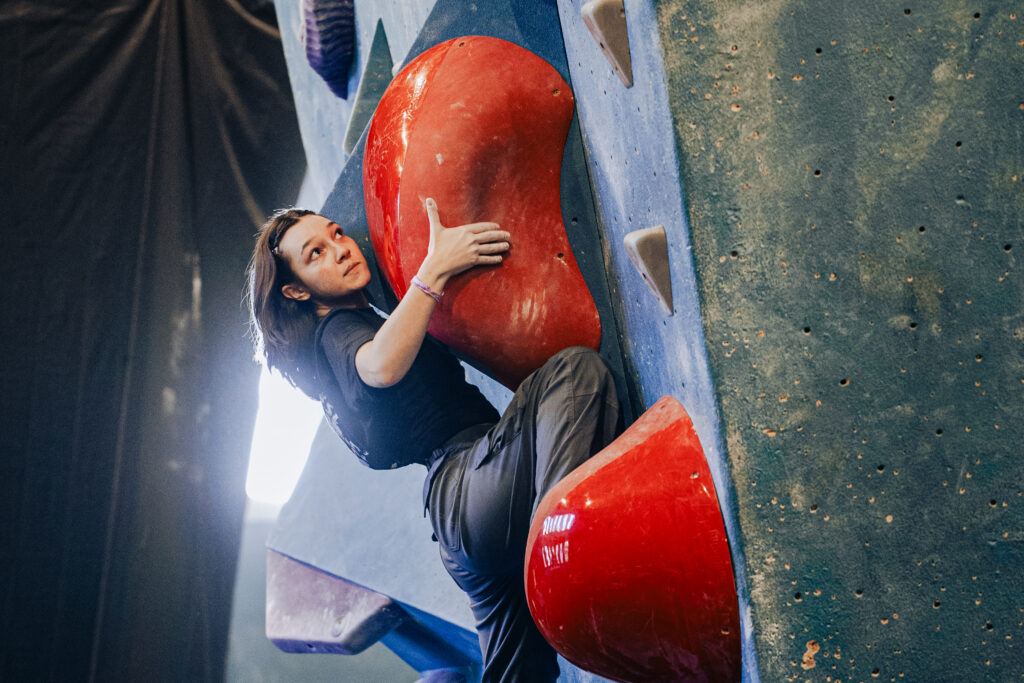
We love that bouldering is a playful challenge. It is what keeps us engaged. Each color represents a route at a certain level of difficulty, giving us something tangible to work toward while leaving room for interpretation in how we get there. We always leave with something more to master or refine. We are an ever-evolving project as humans, and so is our fitness life with bouldering.
At Bouldering Project, routes are referred to as “projects,” leaning into the idea of evolution over perfection. Success becomes less about a black-and-white outcome of making it to the top of a boulder, and more about pushing yourself past your original limits. As we boulder, we move the finish line further.
Progress might look like reaching one hold higher, refining foot placement, or discovering a more efficient sequence of movement. There is often a project left unfinished, but that is part of what fuels the desire to come back and try again.
Mental play + neuroplasticity
Bouldering invites mental play into our full body strength training. Our brains naturally become familiar with repetitive patterns, settling into the grooves created through repeated movement. When patterns become automatic, growth can slow.
Bouldering Project gyms reset our boulder problems frequently, which means climbers are consistently invited to engage with new puzzles and approach movement from a fresh perspective. Each route requires problem solving, spatial awareness, and adaptability. We are asked to interpret the wall differently each time we boulder, exploring new movement patterns and the coordination between the mind and our physical body.
This ongoing process keeps the brain “on,” lighting up new neural pathways and supporting neuroplasticity, which is the brain’s ability to adapt and evolve through experience. Mental play becomes part of the workout, encouraging curiosity, engagement, and resilience. Just as muscles respond to new challenges, the brain benefits from variation, complexity, and the opportunity to learn something unfamiliar. Through constant mental play, bouldering supports both cognitive flexibility and physical development.
Final Thoughts
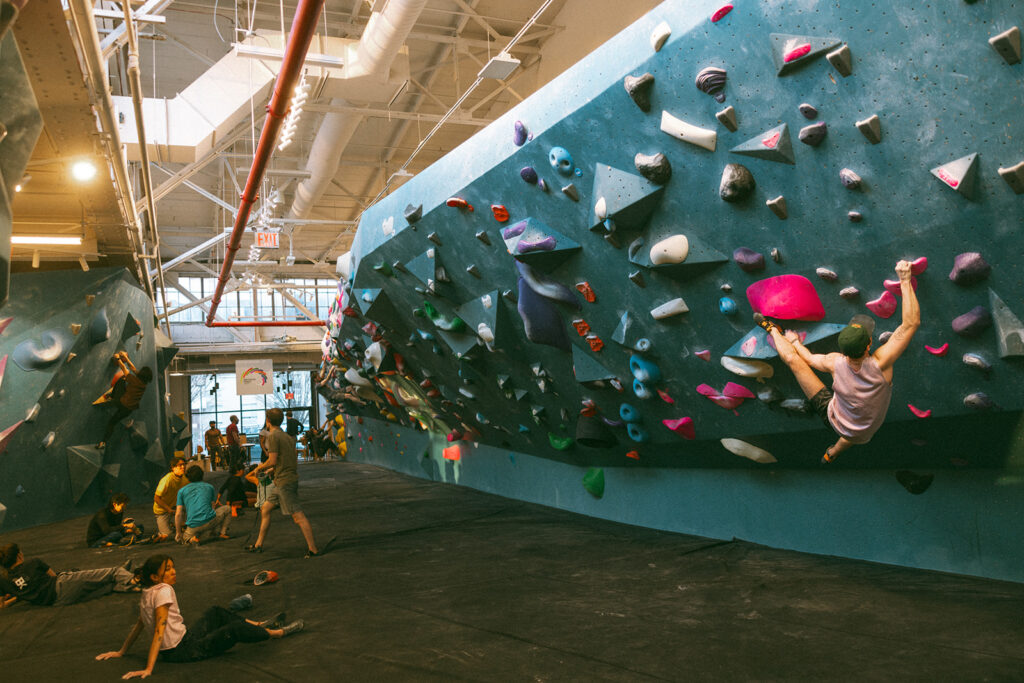
Bouldering is truly a full body workout that stretches both the limbs and the mind, moving from one hold to another with curiosity and intention. The walls become laboratories where we explore the capacity of our physical bodies while integrating strength, coordination, and adaptability through movement.
Check us out and find out why we’re so joyfully obsessed with this sport.
About the Writer: Kenzie Bicher teaches yoga and Pilates at Seattle Bouldering Project, where she explores the connection between movement and language as intertwined forms of expression. With a foundation in somatic practice, her writing is embodied, visceral, and invites readers into a holistic experience.
Climbing and Community: The Boston Indoor Climbing Scene
Written by: Anne Riddle-Cruz Analog Connections: Boston’s Indoor Climbing Scene Boston knows a thing or two about athletic excellence. Climbing...
A Beginners Guide to Mat Pilates
Written by: Kenzie Bicher In our last post, we talked about the benefits of a consistent Pilates practice. Now...
How to Start Rock Climbing in Austin
Written by: Anne Riddle-Cruz Step Onto the Pads: How to Start Rock Climbing in Austin Austin is one of...
The Best Places to Go Rock Climbing in Austin
Written by: Anne Riddle-Cruz Central Texas Limestone: A Local’s Guide to Rock Climbing in Austin The city of Austin...
Bouldering Project’s Signature Yoga Classes
Written by: Kenzie Bicher Bend, Don’t break. Our yoga classes are designed for flexibility, mindfulness, and strength. Gradually...
The Functional Benefits of Pilates
Written by: Kenzie Bicher The Functional Benefits of Pilates Pilates is a buzzword that pops up everywhere. If you've...