


What Muscles Does Rock Climbing Work?


Written by: Kenzie Bicher
What Muscles Does Rock Climbing Work?
The answer: just about every muscle.
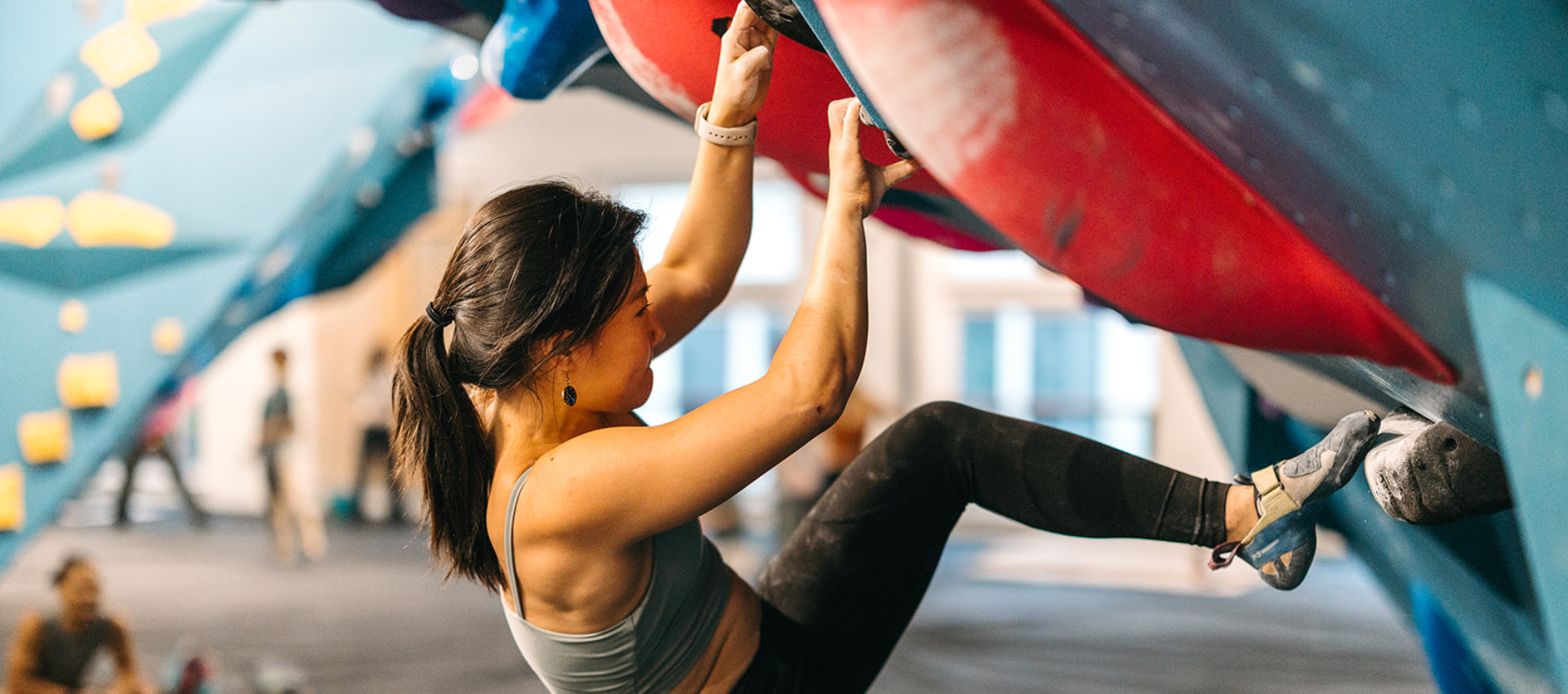
Your body acts as a mechanism, transferring energy from one place to the next. While climbing, we read the wall, sense shifts in body weight, leverage our weight to make energy-efficient moves, and respond in real time. All the muscular units work in tandem to refine our spatial awareness and sharpen each reach, press, push, and pull.
Grip
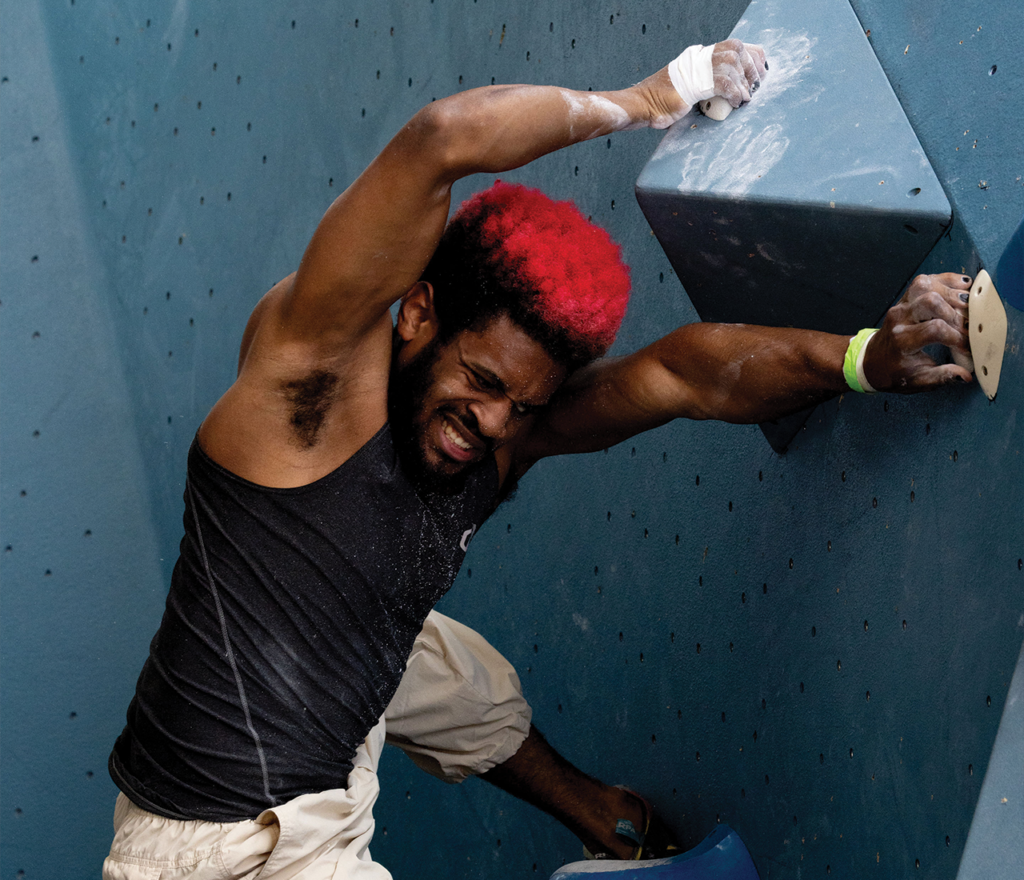
Chalk up. Fingers curl around the starting holds.
The tension between the fingers and the surface keeps us on the wall.
We generate this tension to resist gravity’s constant downward pull. Micro-movements in the fingers can determine whether we stay or slip. Small, intricate muscles in the fingers, wrists, and forearms create the force needed to hold on. These muscles develop endurance, producing constant contraction over time rather than a single burst of effort. This process causes the familiar “pump”: that burning fatigue when blood flow struggles to keep up with demand.
- Finger flexors curl the fingers around the hold.
- Wrist flexors stabilize and position the hand relative to the hold.
- Forearm muscles maintain tension and build endurance over time.
With practice, these muscles adapt. They learn to sustain tension longer, delay fatigue, and recover more efficiently between efforts.
Reach
Reach isn’t about the pull from our arms.
As one hand moves, the rest of the body reorganizes to support the shift in weight and balance. These fine-tuning muscle units are constantly adjusting beneath the surface to accommodate subtle shifts. The shifts move through the body’s kinetic chain.
The core unit provides constant stabilization and control, from the deepest core muscle to the most surface-level muscle.
- Rectus abdominis (abs) stabilizes and assists with flexion; it is our surface abdominal muscle, what we think of as a traditional “six pack.”
- Obliques (abs) sit on both sides of the body, dialing in side-to-side movement and supporting rotation in the trunk or that long reach just above you.
- Transversus abdominis (abs) creates internal support. It runs deep from the spine, curving forward along the midline, similar to a corset.
The back and shoulder unit creates the action of the reach, while the rest of the body provides support for the movement pattern.
- Latissimus dorsi (lats) are the large pulling muscles connecting the arm to the torso.
- Teres Major (lats) supports the lat muscles with extra movement capacity.
- Rhomboids (upper back muscles) retract the shoulder blades, keeping the chest open and stable.
- Serratus anterior (boxer’s muscle) anchors the shoulder blade to the ribcage, crucial for a slow, controlled reach
- Rotator cuff stabilizes and fine-tunes the shoulder joint.
Working together, the core, back, and shoulder units create coordinated tension. As different muscles engage, the hand moves while the rest of the body supports us on the boulder.
Reaching on the wall also demands mobility. Holds don’t always sit directly above us – they span multiple planes. Each reach lets us practice moving joints through space with both freedom and control.
Push
The arms’ reach only works with the push from the lower body.
Trust the feet. They connect to the calves, hamstrings, quadriceps, and hip flexors, forming a continuous chain for force production and upward movement. The legs generate power through the footholds to drive the body up the wall.
The core unit stabilizes the spine and pelvis, controlling tension through the trunk so that force from the legs is efficiently transmitted into upper body reach and movement. This allows the push from below to connect seamlessly with the reach above.
The lower body unit is a powerful reservoir of movement capacity.
- The ball of the foot channels force into the wall, creating a stable point of contact.
- Calves engage to press through the toes, especially on smaller footholds.
- Adductors or inner thighs draw toward the midline, creating stability and tension.
- Quadriceps extend the knee, driving the body upward.
- Glutes power hip extension, providing strength and control
- Hip flexors lift and position the foot accurately for the next step.
The more we trust the feet to translate our push up the legs, the lighter the climb feels.
Integration
In climbing, grip, reach, and push aren’t separate actions, but parts of a continuous exchange between body, wall, and gravity. As our awareness deepens, strength builds. Movement is less about holding on and more about understanding where to go next.
Top Out
You made it to the top? Now what?
Supplement your climbing with precision and balance. To progress your bouldering practice, off-the-wall training plays a key role. Strength and conditioning classes develop the capacity to generate and sustain force across repeated efforts, while yoga supports joint mobility, flexibility, and recovery. Bouldering Project offers the full package to ensure your body moves freely on and off the wall. Take a look at our offerings here.
About the writer: Kenzie teaches yoga and Pilates at Seattle Bouldering Project, where she explores the connection between movement and language as intertwined forms of expression. With a foundation in somatic practice, her writing is embodied, visceral, and invites readers into a holistic experience.
Climbing and Community: The Boston Indoor Climbing Scene
Written by: Anne Riddle-Cruz Analog Connections: Boston’s Indoor Climbing Scene Boston knows a thing or two about athletic excellence. Climbing...
A Beginners Guide to Mat Pilates
Written by: Kenzie Bicher In our last post, we talked about the benefits of a consistent Pilates practice. Now...
How to Start Rock Climbing in Austin
Written by: Anne Riddle-Cruz Step Onto the Pads: How to Start Rock Climbing in Austin Austin is one of...
The Best Places to Go Rock Climbing in Austin
Written by: Anne Riddle-Cruz Central Texas Limestone: A Local’s Guide to Rock Climbing in Austin The city of Austin...
Bouldering Project’s Signature Yoga Classes
Written by: Kenzie Bicher Bend, Don’t break. Our yoga classes are designed for flexibility, mindfulness, and strength. Gradually...
The Functional Benefits of Pilates
Written by: Kenzie Bicher The Functional Benefits of Pilates Pilates is a buzzword that pops up everywhere. If you've...